
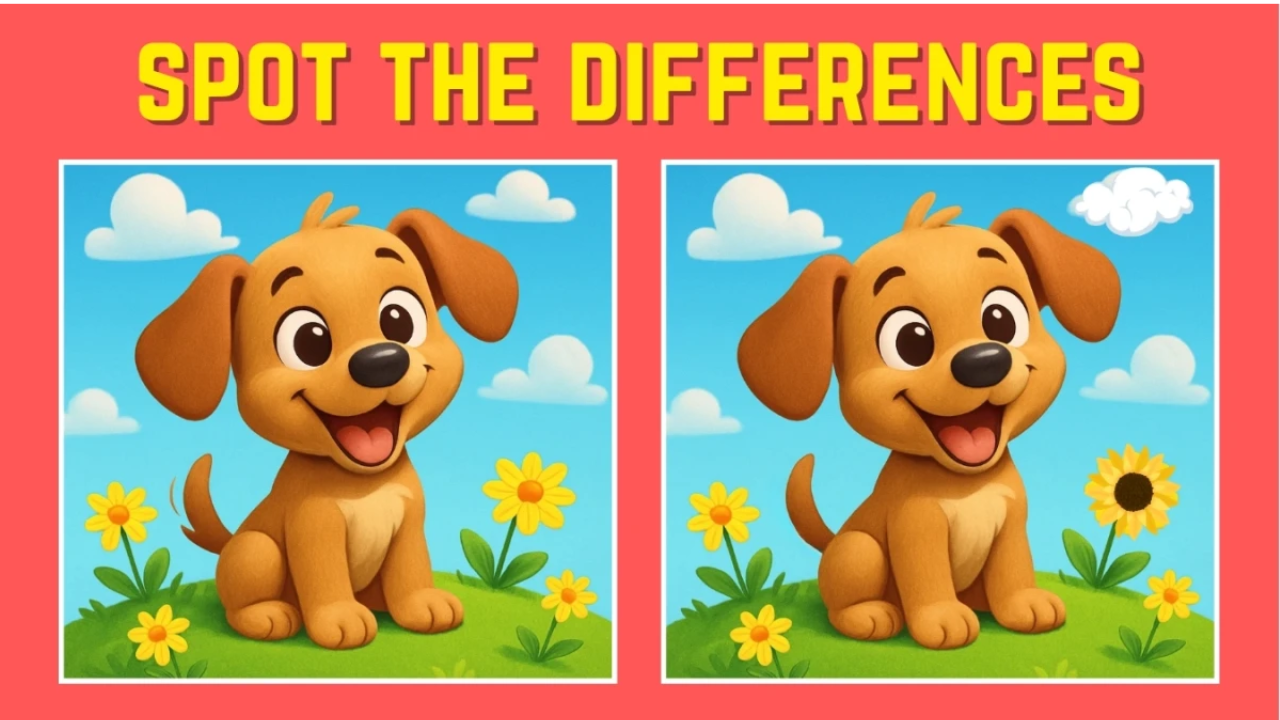
Spot the Difference” puzzles are a popular and fun way to challenge your brain while improving your visual perception. The premise is simple: two images appear to be nearly identical, but they hold small, subtle differences that you need to find before time runs out. These visual challenges test your attention to detail, cognitive speed, and ability to focus under pressure. The “Spot the Difference” puzzle we’re discussing today raises the stakes with a twist—only 1% of visual geniuses can spot all three differences in the given time. Do you have what it takes to beat the challenge? Let’s find out!
The Challenge: Spot the Three Differences
In this particular “Spot the Difference” challenge, you’re given two almost identical images of two cute puppies. At first glance, everything seems to be the same—until you start looking closer. The task is to find the three subtle differences that separate these two pictures. These discrepancies can range from small changes in shapes, colors, or positions of elements within the images.
The clock is ticking, and the challenge isn’t just about speed; it’s about noticing tiny differences that are easily overlooked. Your observation skills and mental agility will be put to the test as you race against time to find all three differences.
Why “Spot the Difference” Puzzles Are So Effective
“Spot the Difference” puzzles are more than just an enjoyable way to pass the time. They offer several cognitive benefits that can help improve your mental sharpness and focus. Here are some reasons why these puzzles are so effective:
- Improved Attention to Detail: The subtle nature of the differences in these puzzles trains you to observe tiny details, something that can be beneficial in other areas of life, like work or studies. The more you practice, the sharper your attention to detail becomes.
- Enhanced Cognitive Processing: As you work through these puzzles, your brain gets better at quickly processing visual information. This cognitive agility is not just useful for puzzles—it helps you solve real-life problems and make decisions faster and more effectively.
- Boosted Focus and Concentration: The pressure to find the differences in a short time helps build concentration and focus. Over time, this improves your ability to stay focused on tasks in daily life, whether it’s working on a project or managing multiple responsibilities.
- Pattern Recognition: “Spot the Difference” puzzles challenge your brain to quickly spot changes in visual patterns. This skill is transferable to other tasks, such as identifying trends in data, recognizing errors in a system, or even making quick decisions in high-stress situations.

The Solution: Revealing the Three Differences
Now, let’s talk about the solution to this tricky challenge! After scanning the two images of the puppies, were you able to find all three differences? If not, don’t worry—this puzzle was designed to be tough, and even the most observant may need a little help. Here are the three subtle differences:
- The Clouds: The first difference appears in the clouds at the top of the image. In the right image, the cloud on the right is slightly altered. This cloud is not shaped the same as it is in the left image, and this small change might be hard to spot if you’re not paying close attention.
- The Puppy’s Tail: The second difference lies in the puppy’s tail. While the left image shows the tail in a gentle curve, the tail in the right image has been altered, making the shape or curve different. This is a small detail that can be tricky if you’re focusing more on the puppies’ faces.
- The Flowers: The final difference is in the flowers. In the right image, one of the flowers on the right side has a dark brown center, while in the left image, the same flower has a yellow center. This color change is subtle but distinct once you know where to look.
