
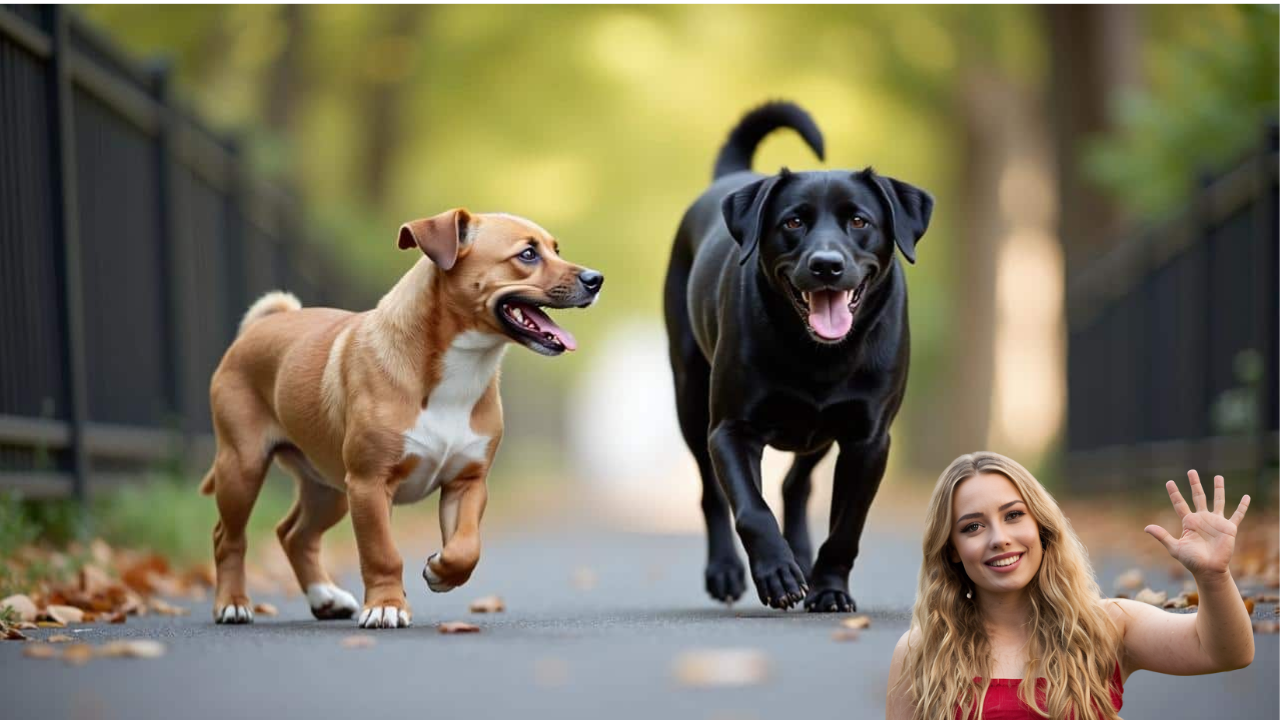
She just lifts her hand, opens her fingers in a small, bright wave, and says softly, “Hey, buddy,” to a terrier she’s never seen before. The dog’s tail helicopters. The owner smiles, then almost looks relieved, as if this tiny moment has made the morning less sharp.
Top 3 Dogs for House Safety – Best Guard Dogs for Home Protection
Twenty seconds later, a man with headphones walks past another dog. Eyes straight ahead. Hands in pockets. The spaniel looks up hopefully, then goes back to sniffing the pavement like nothing happened. On the same street, two worlds co-exist: people who greet dogs and people who don’t.
Psychologists have started paying attention to this tiny, funny detail. Because the way you instinctively wave “hello” to a stranger’s dog might not be random at all.
What your “hello” to random dogs quietly reveals about you
Ask any dog owner: the street becomes a social laboratory. Some passersby lower themselves to the dog’s height, wave like they’re meeting a small child, and light up for five seconds. Others walk past as if the dog were a mailbox. That split-second choice looks trivial. Researchers say it often isn’t.
:max_bytes(150000):strip_icc()/how-to-pet-a-dog-966271250-2000-00a66f4b45734faab46fbf01ac5e612b.jpg)
Several personality studies link spontaneous interaction with animals to traits like openness, warmth and what psychologists call “social approach motivation”. In plain language, that’s your inner drive to connect, even when there’s no obvious reason. A quick wave at a dog you don’t know is basically a micro-declaration: “I am open to this moment.”
We like to think our personalities show up in big moments, during job interviews or arguments. But psychologists argue that our real signatures leak out in tiny, unscripted gestures. A hand raised to a passing dog is one of those leaks.
In one small study often cited in discussions about pet-related behavior, researchers found that people who described themselves as highly empathetic were far more likely to initiate contact with unfamiliar animals in public spaces. The team didn’t just ask questions; they observed people in parks, on city streets, at café terraces. Who reached out first? Who made eye contact with animals? Who avoided them?
Patterns emerged fast. People high in extraversion weren’t just more likely to talk to strangers — they were more likely to talk to strangers’ dogs. Those who scored high on agreeableness, the “kindness” dimension of personality, often used softer voices and gentle hand gestures, like a quiet wave. It wasn’t a grand, theatrical move. More a reflex of inclusion: you’re here too, little guy.
Psychologists looking at these everyday rituals link them to what they call “anthropomorphic sensitivity” — how readily you treat non-humans as minds rather than objects. People who wave at dogs tend to score higher on this. They’re more likely to use words like “he” or “she” instead of “it” when talking about animals. They also report feeling less alone when animals are around, even if they never touch them.
